Three generations in a single workshop, and the discovery that a craft survives not by staying the same, but because someone cares enough to carry it somewhere new.
He had spent most of his life learning how to make things slowly.
In a world that increasingly valued speed, he had chosen patience.
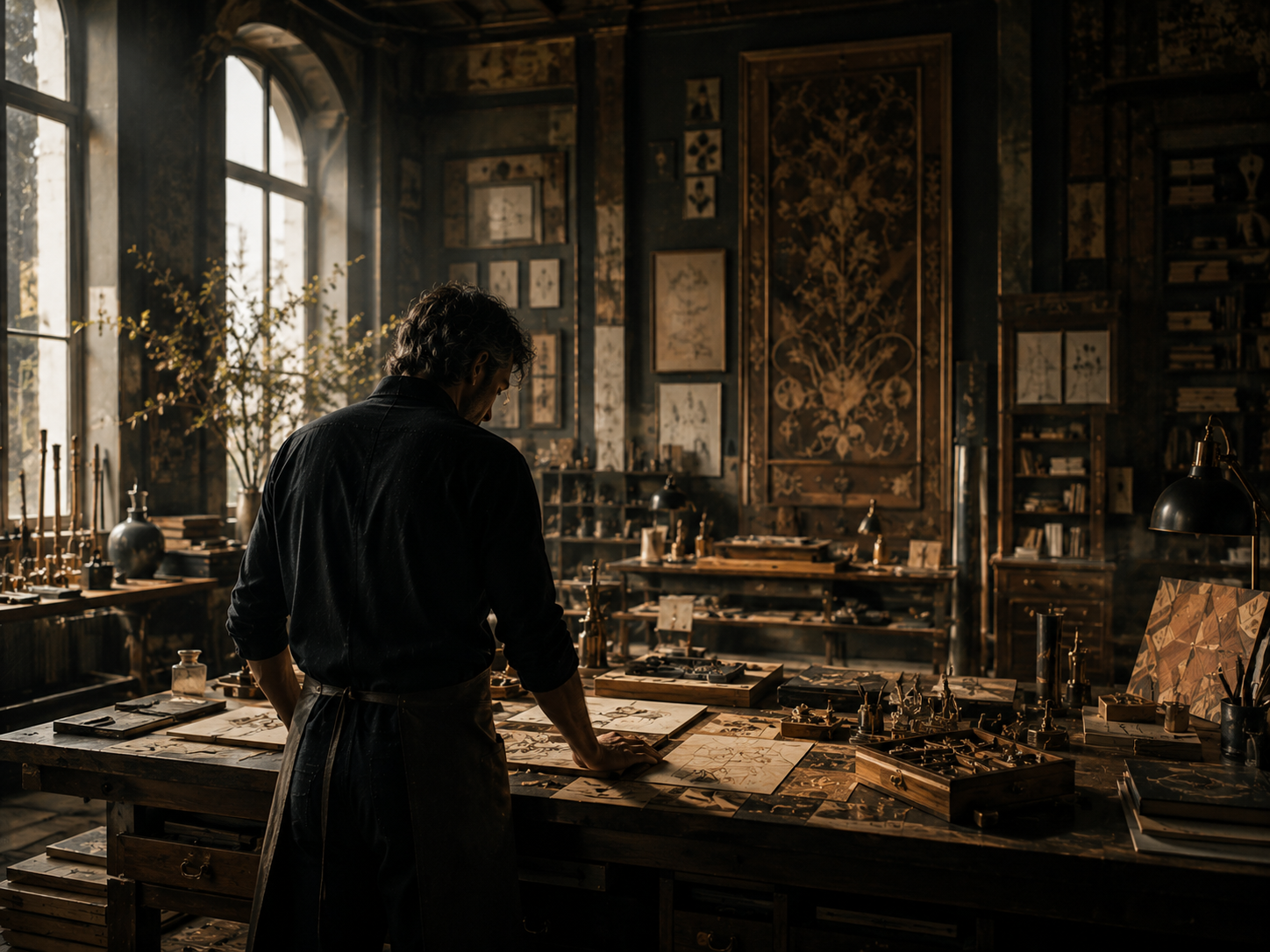
His studio sat behind an unassuming door on a quiet street, but inside was another world: tall windows, worn wooden benches, drawers filled with tools, sketches pinned to the walls, carefully selected materials and shelves carrying objects in various stages of completion.
Nothing was there by accident.
Some things had been made by his grandfather. Others by his father. Others still by him. And some had never been finished at all.
He had inherited the craft from two generations before him. But inheritance, he had learned, was not the same as ownership.
You didn't simply receive a craft. You received the responsibility of carrying it forward.
His grandfather had taught him the fundamentals. His father had taught him patience. Neither had taught him everything.
That was deliberate.
There were things that could be explained: how to hold a tool, how much pressure to apply, how to read a material, how to recognise when something was beginning to fail.
But there were other things that could only be learned through repetition. Through mistakes. Through watching. Through doing the same thing hundreds of times until the hands began to understand before the mind did.
His father used to say: “The material will tell you what it wants.”
He hadn't understood what that meant when he was young. He did now.
The craft had become rare. Not forgotten. Not quite. But rare enough that most people would never see it being made.
Machines could reproduce patterns in seconds. Computer modelling could create forms with extraordinary precision. Modern manufacturing could produce thousands of identical objects.
And there was nothing wrong with that. He used many of those technologies himself.
What concerned him was something else. People had begun to believe that because something could be made faster, it automatically became better.
He didn't believe that. Some things needed time.
Not because time made them more valuable. Because time changed the maker.
Every mistake taught something. Every failed piece altered the next. Every generation left something behind for the one that followed.
That was how the craft had survived. Not by standing still. By changing.
One afternoon, a young designer joined the studio. She had studied contemporary design and understood materials in a completely different way.
She worked quickly. She sketched digitally. She modelled ideas before touching the material. She questioned almost everything.
At first, he found this irritating. She found him frustrating.
“You spend too long making decisions,” she told him one afternoon.
“And you make yours too quickly.”
She smiled. “Perhaps that's why we're here.”
He looked at her. Then laughed. Perhaps she had a point.
Over time, they began learning from one another. She showed him new ways of modelling forms. He showed her how to recognise when an idea looked better on a screen than it felt in the hand.
She introduced materials he had never considered. He taught her why some old techniques had survived for generations.
They disagreed. Often. But disagreement became part of the process.
So did failure. Pieces cracked. Patterns didn't work. Materials behaved differently than expected. Some experiments were beautiful. Others were disasters.
They kept going. Because neither of them was trying to recreate the past. They were trying to understand what the past might allow them to do next.
One afternoon, while searching through an old cabinet, she discovered a drawer that had not been opened in years. Inside was an unfinished piece.
It was unlike anything else in the studio. The design was ambitious. Perhaps too ambitious. There were handwritten measurements on the back. His father's handwriting.
She looked at him. “What is it?”
He studied the object for a moment. “My father started it.”
“And?”
“He couldn't finish it.”
“Why?”
“I don't know.”
“Did you try?”
He was quiet. “Yes.”
“And?”
“I couldn't.”
She looked at the unfinished piece. “Why don't you finish it now?”
He smiled. “Because I'm not sure it belongs to me.”
She frowned. “Whose does it belong to?”
He looked at the object again. “Perhaps the person who finally understands what it wants to become.”
She became fascinated by it. For weeks, she studied the drawings. Not to reproduce them. To understand them.
She discovered that the original idea had been limited by the materials available at the time. The concept wasn't wrong. It had simply arrived before its moment.
That changed everything.
She began experimenting. He watched. At first, he said very little. Then he began contributing. An old technique. A new material. A different way of joining two surfaces. A modern tool used for an ancient process.
Something began to emerge. It was neither his father's work nor hers. It belonged somewhere between them.
Something inherited. Something changed. Something new.
One afternoon, he watched her work. Her hands moved differently from his. She had learned his techniques, but they had already become her own.
He suddenly remembered being that age. His father standing behind him. Correcting his grip. Telling him to slow down. Letting him make mistakes.
He had once believed his father was teaching him how to make things. Now he understood. He had been teaching him how to continue.
That was the real inheritance. Not the tools. Not the workshop. Not even the techniques. The courage to take what you had been given and discover what it could become.
The finished piece took months. When it was finally complete, it wasn't a reproduction of anything that had come before.
It carried traces of the old craft. You could see the discipline in it. The patience. The precision. But there was something unmistakably contemporary about it too.
He stood beside her and looked at it. For a long time, neither spoke.
Finally, she asked: “Is it right?”
He smiled. “It's different.”
She looked disappointed. Then he added: “Good.”
That evening, after she had gone, he remained alone in the studio. He walked slowly between the benches.
His grandfather's tools were still there. Some were worn smooth by decades of use. His father's drawings remained in their old drawers. Beside them were new instruments his apprentice had introduced.
Old and new. Not competing. Working together.
He looked at the piece his father had once abandoned. It was no longer unfinished. But it wasn't finished in the way his father had imagined.
Perhaps that was the point.
He had spent years believing that preserving the craft meant protecting what had been handed down to him. Now he understood something different.
The craft had survived precisely because nobody had kept it exactly the same.
His grandfather had changed it. His father had changed it. He had changed it. And now someone younger would change it again.
That wasn't the loss of tradition. That was tradition.
He turned off the lights one by one. The studio became quiet. Only a single lamp remained above the workbench.
Under it sat the finished piece. Beside it were the old tools. And the new ones.
For a moment, he thought about all the hands that had come before his. Hands that had learned. Failed. Improved. Passed something on.
Then he thought about the hands that would come after.
He smiled.
A craft does not survive because it remains unchanged. It survives because someone cares enough to learn it, question it and carry it somewhere new.
The hands remember. But they were never meant to make exactly the same thing twice.
Continue the thread
The story
What We Leave Standing
An architect who had spent thirty years imagining what comes next finds, beneath an old steel crossing on the edge of London, a question she had never thought to ask.
Open