An architect who had spent thirty years imagining what comes next finds, beneath an old steel crossing on the edge of London, a question she had never thought to ask.
For thirty years, she had been paid to imagine what came next.
Buildings had risen beneath her drawings in cities she had once known only from maps. Hotels, residences, galleries, private houses and public spaces had carried her signature in ways most people would never notice.
She knew the language of architecture intimately.
Stone. Steel. Glass. Light. Space.
She knew how a staircase could make someone slow down, how a window could frame a city like a painting, and how the finest buildings rarely revealed themselves all at once.
They unfolded gradually.
She had spent most of her career looking forward.
And she had become very good at it.
The commission arrived in London on a grey morning in early autumn.
An old industrial quarter on the edge of the city was being transformed.
Warehouses had become studios. Former factories had become restaurants and residences. New towers were rising above the older streets, their glass catching the changing light.
Her firm had been asked to design the centrepiece of the redevelopment: a new development combining private residences, a hotel, cultural spaces and restaurants.
It was ambitious. Elegant. Forward-looking.
She liked it immediately.
There was only one problem.
An enormous steel structure crossed the road at the centre of the site.
Old. Riveted. Weathered.
It had once been part of the district's industrial infrastructure, but now served no obvious purpose.
The developers wanted it removed.
She agreed. At first.
It was expensive to retain, difficult to incorporate and, she thought, belonged to another era.
Cities had to evolve.
She had spent her life believing that.
Why should this be different?
She visited the site just before sunset.
The road was almost empty.
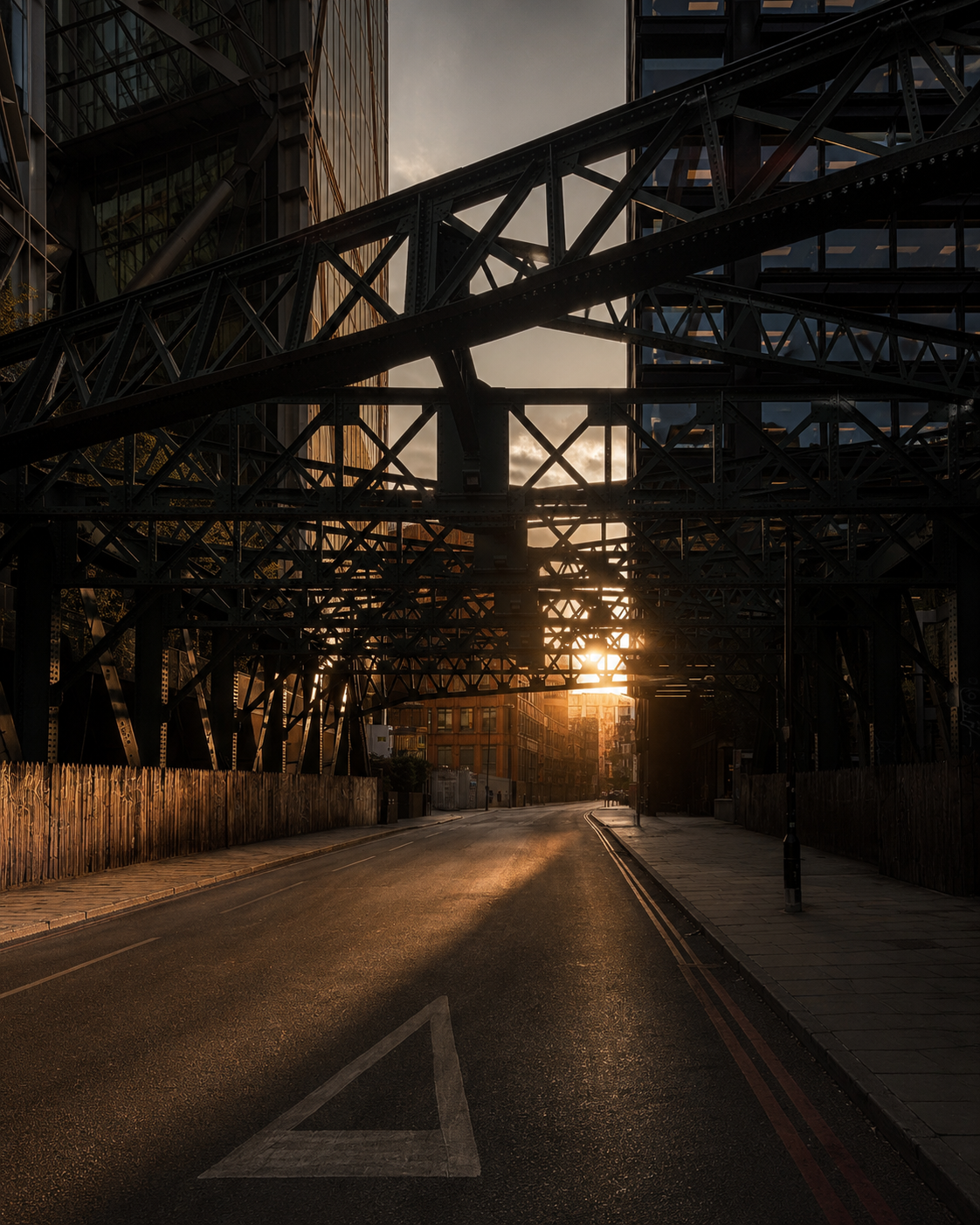
Above her, the steel formed a complicated lattice against the sky. Behind it, modern buildings rose into the fading light.
She studied it through the eyes she had trained for decades.
Angles. Proportion. Perspective. Potential.
It was beautiful in a way she hadn't expected.
She took a photograph. Then another.
"Still want it gone?" asked the young engineer beside her.
"Yes."
"Even after seeing it?"
She smiled. "Especially after seeing it."
He laughed. "That's cold."
"It's architecture."
She turned towards the new buildings.
"Cities can't become museums."
Then she walked on.
She didn't notice the small brass plate fixed to one of the lower beams.
She would not notice it until much later.
The following morning, an elderly man was sitting on a bench near the site.
He had worked in the area for most of his life, in one of the workshops that had once surrounded the structure.
He remembered when the road had been full of delivery trucks, when the river was something workers crossed rather than something people photographed from restaurants.
She asked what he thought of the redevelopment.
"Cities change," he said.
"That's what I keep telling everyone."
He looked at her. "That's not necessarily a good thing."
She smiled. "No?"
"No. Just a thing."
That stayed with her.
She asked what should happen to the old steelwork.
"Most people don't notice it anymore."
"Should they?"
He looked towards the structure. "Maybe that's not the point."
He told her his father had worked there. Then he had. His son had left.
"He still comes back sometimes."
"Why?"
The old man looked towards the river. "Because some places remember you."
She didn't photograph him.
As she stood to leave, he looked at her camera.
"You're taking pictures of it?"
"Yes."
He studied her. "Then don't only photograph what everyone else can see."
She smiled politely.
She assumed he meant the buildings.
She didn't realise he meant something else.
That evening, the development team met for dinner.
Plans covered the table. New residences. A hotel. Restaurants. A gallery. Private gardens.
Everything had been considered. Everything had a number beside it.
One of the investors looked at her.
"We aren't asking you to preserve a relic. We're asking you to create something people will want to come to."
She understood.
This was what she did.
She knew how to make places desirable. How to remove the awkwardness from a site and replace it with something cleaner, more valuable, new.
And yet she kept thinking about the old man's words.
Some places remember you.
She dismissed the thought.
Sentiment had never been a particularly useful design principle.
The next morning, she opened the original plans.
In the margin of one of the earliest drawings was a handwritten note.
Three words. Leave this visible.
She stared at it.
There was no name.
The archive team initially attributed it to the original architect.
Then she noticed the handwriting didn't match his other drawings.
Someone else had written it. Who?
No one knew. The original records were incomplete.
Only the three words remained. Leave this visible.
She returned to the site that evening.
The sun was low. The old steel turned almost black against the sky.
She walked beneath it slowly.
For the first time, she wasn't thinking about how to remove it. She was looking at it.
The rivets. The repairs. The marks left by time.
At the far end, almost hidden beneath layers of paint and rust, she noticed the brass plate.
She brushed away the dirt.
Four words appeared. For those who remember.
No name. No date.
She photographed it. Then stood there for a long time.
The following week, she changed the proposal. Not completely.
New buildings would still rise. The hotel would remain. The residences would remain.
But the old steel would stay too.
The new architecture would work around it. Walkways would pass beneath it. A public space would open beside it.
The first meeting went badly.
"It's inefficient."
"Yes."
"Expensive."
"Yes."
"Architecturally awkward."
She looked at the drawings. "That's the point."
One investor leaned back. "You've spent thirty years making things simpler."
She smiled. "Perhaps I've spent thirty years making them simpler than they needed to be."
For months, the project moved between approval and collapse.
Budgets changed. Plans changed. People changed their minds.
At one point, the preservation element was almost removed.
She nearly let it go. It would have been easier.
Then she remembered the old man.
My father worked here. I worked here. My son left.
The people who built places rarely remained long enough to see what those places became.
But their work stayed. Sometimes quietly. Sometimes unnoticed. Sometimes beneath layers of change.
Perhaps that was the point.
A week before final approval, an envelope arrived at her office. No return address.
Inside was a photograph of the same steel structure decades earlier.
The road was crowded with workers and trucks.
On the back, someone had written: You are looking at the wrong thing.
She called the archive. No one knew who had sent it.
She called the old man.
After a long silence, he said: "Perhaps you should ask why someone kept it."
Then he hung up.
The next morning, she returned to the site with the photograph.
She stood where the old image had been taken.
The structure was still there. The road had changed. The buildings had changed. The people were gone.
But in the old photograph, at the far end of the road, a young woman stood beneath the steel holding a camera.
Something about her felt familiar.
Then she recognised the camera.
Her father had owned one. She had grown up seeing it in their family home.
Her father had been an architect.
The architect whose drawings were in the archive.
The architect whose name was attached to the original structure.
She had never known he had worked on the project.
She had never known he had photographed the people around it.
And she had never known he had written those three words. Leave this visible.
That evening, she opened an old box she hadn't touched in years.
Inside were drawings, letters and photographs.
At the bottom was a small notebook.
Her father's handwriting filled the first pages.
Then she found a sentence: A building should never be judged only by what it becomes. It should also be remembered for what it allowed people to become.
She sat quietly.
Suddenly the project wasn't only about the city.
It was about him. And perhaps, without knowing it, about her.
The project was finally approved.
Not exactly as she had imagined. Not exactly as the investors had wanted.
The old steel remained. New buildings rose around it.
Former industrial spaces became studios, galleries and restaurants.
People walked beneath the structure without necessarily knowing its history.
Some stopped. Some photographed it. Some simply passed through.
And that was fine.
It didn't need everyone to understand it. It only needed to remain.
On the evening before the opening, she returned alone.
There were no speeches yet. No guests. No photographers. Only the fading light.
She stood beneath the steelwork and remembered the first question she had asked herself:
What should we build here?
Now she understood the real question. What deserves to remain?
She looked towards the new towers. They were beginning to catch the last light.
For years, she had thought of old and new as opposing ideas.
Now she saw them differently.
The old structure did not prevent the city from moving forward. It gave the future something to remember.
She thought about her own life. The buildings she had designed. The cities she had left. The friendships that had faded because there had always been another project, another flight, another deadline.
She had spent so long constructing what came next that she had rarely asked what she had left behind.
Perhaps people were not so different from cities.
We carry our earlier lives beneath the surface. Some things are renovated. Some are repaired. Some disappear. And some, if we are fortunate, remain.
The light was almost gone.
She took out her camera. Not for the project. Not for the client. Just for herself.
She stood in the middle of the road. The steel crossed above her. The new buildings rose behind it. The last sunlight travelled between them and fell onto the empty street.
She raised the camera. Then stopped.
For a moment, she simply looked.
She didn't need to improve the composition. She didn't need to make the old structure more beautiful.
It already was. Not because it was perfect. Because it had endured.
She took one photograph. Then lowered the camera.
She began walking towards the river.
After a few steps, she looked back.
The old steel was almost invisible against the darkening sky. Behind it, the new towers were beginning to light up.
For years, she had believed those two things could not belong together. Now she wasn't so sure.
She kept walking.
Behind her, the old structure remained. Ahead, the city continued to change.
At the river, she stopped.
Something moved beneath the structure. A small light, reflected in the water. A bicycle, perhaps. Or someone carrying a lamp.
It disappeared before she could make out what it was.
She smiled.
For once, she didn't turn around to investigate.
Some things, she had finally learned, were more beautiful when they remained partly unknown.
Behind her, beneath the steel, the brass plate remained. For those who remember.
She had spent thirty years believing architecture was about creating what came next.
Now she understood that sometimes it was about giving the past somewhere to remain.
She walked on.
And for the first time in years, she didn't know exactly where she was going.
She found that she liked the feeling.
Because perhaps the greatest thing a place can give us is not an answer.
Perhaps it is a question we carry with us when we leave.
Continue the thread
The story
Made by Time
Three generations in a single workshop, and the discovery that a craft survives not by staying the same, but because someone cares enough to carry it somewhere new.
Open