A photographer who had followed light across continents finds, beneath an old arch in southern Spain, that the most important movement is backwards.
For most of her adult life, she had followed light.
It had carried her across continents and through lives she could once scarcely have imagined touching. She had worked beneath the hard brilliance of Australia, through winters in Japan, along the long roads of India and across the vast landscapes of Africa. She had returned to New Zealand more than once, and worked in Paris and Buenos Aires, in cities she knew intimately and others whose names had meant almost nothing to her until she arrived with a camera in her hands.
Some journeys lasted only a handful of days. Others stretched into seasons. A fortunate few became chapters she would carry long after she had left.
She had photographed grand hotels and private houses, ancient streets and modern spaces, coastlines, markets, workshops and the faces of people whose lives were entirely different from her own.
Yet she had never thought of herself as someone who collected destinations.
What she collected were the stories that lived within them.
That distinction had become important to her.
A photograph, she had always believed, was never simply what appeared inside the frame. There was something before it: a conversation, a journey, a person, a decision. And there was always something afterwards: a life continuing beyond the instant the shutter closed.
That was what interested her.
Not simply where she had been, but what she had found there.
San Aurelio was an old city in the south of Spain, the sort of place that seemed to have gathered its history rather than put it on display.
Pale stone buildings lined its broad avenues. Narrow streets disappeared behind heavy wooden doors. Courtyards opened unexpectedly from quiet lanes, filled with citrus trees and the soft sound of water. Small workshops occupied buildings that had belonged to families for generations.
In the late afternoon, the city changed.
The brightness softened. The stone warmed. Shadows lengthened across the pavements and, one by one, lights began to appear behind windows.
She had been commissioned to photograph the city for an international series exploring its architecture, craftsmanship and the people who continued to live among both.
She knew how to photograph a place like San Aurelio.
She knew how to find the angle.
How to wait for the right light.
How to let a person enter a frame at precisely the right moment.
What she didn’t know was what the city would give her.
So she walked.
And listened.
Her first real conversation was with a craftsman restoring the interior of an old building.
He had been working with wood for almost forty years.
She photographed his hands before she photographed his face.
They were marked by the work, the skin roughened around the fingers, his movements careful but confident.
She asked how long the restoration would take.
He laughed.
“Longer than you would like.”
She smiled.
He explained that old wood could not be rushed. It had its own character. If he worked against it, the material would eventually show him.
She asked whether patience came naturally to him.
He looked at her.
“No,” he said. “I had to learn it.”
She remembered that.
She had spent years waiting for perfect light, but perhaps patience wasn’t about waiting for the perfect moment.
Perhaps it was about learning to work with the moment you had.
She took another photograph.
This time, she waited longer before pressing the shutter.
A few days later, she found a small family restaurant tucked into one of the older streets.
The woman who ran it had inherited it from her parents, who had inherited it from theirs.
There was nothing showy about the place.
The tables were close together. The kitchen was small. The menu changed with the season.
Yet people kept coming back.
Some had been coming for decades.
The woman told her about customers who had first arrived as children and later returned with families of their own.
There had been weddings.
Arguments.
Birthday dinners.
Reconciliations.
People who had left San Aurelio and returned years later.
People who had never left at all.
The photographer realised that the restaurant was more than a business.
It was a record of people’s lives.
She photographed the kitchen after lunch, when the noise had disappeared and the room was briefly empty.
Before she left, the woman asked where she had lived.
So she told her.
Australia. Japan. India. Africa. New Zealand. Paris. Buenos Aires.
The woman listened with genuine curiosity.
Then she told her about somewhere she had always wanted to see: a place she knew only from photographs.
The photographer could have answered with another story from her travels.
Instead, she listened.
They talked until the light outside began to fade.
When she finally left, she realised that the conversation had felt less like an interview than an exchange.
She had brought stories from far away.
The woman had given her one from home.
Then there was the young artist.
She found him in a studio above an old courtyard, surrounded by half-finished work.
He was thinking about leaving San Aurelio.
He wanted to travel.
He wanted to see what existed beyond the streets he had known all his life.
But he was frightened by the possibility that he might discover he wanted a different life.
She understood that feeling.
She had once stood in a similar doorway with a bag packed and no real idea what waited on the other side.
He asked whether she had ever regretted leaving.
She thought about it.
“No.”
Then she paused.
“But I’ve regretted not staying longer in some places.”
He looked at her.
“Why didn’t you?”
She smiled.
“Sometimes I was too busy getting somewhere else.”
She hadn’t planned to say it.
But once she had, she knew it was true.
She photographed him beside an unfinished canvas.
When she looked at the image later, she noticed something she hadn’t seen at the time.
He wasn’t looking at the painting.
He was looking towards the open window.
Neither leaving nor staying.
Somewhere between the two.
The bookseller came last.
His shop had occupied the same narrow building for most of his life.
He could find a book without looking at the shelves. He remembered customers by what they bought rather than by their names.
When she asked how the city had changed, he thought for a while.
“People think cities change when buildings change,” he said.
He looked towards the street.
“Usually, the stories change first.”
She wrote that down.
She had spent much of her career photographing things that endured: stone, wood, buildings, objects.
But perhaps a place was defined just as much by what happened inside those things.
He asked which of her photographs she liked most.
She couldn’t answer.
There were too many.
He smiled.
“Perhaps that’s your problem.”
She laughed.
“What is?”
“You’ve seen too much.”
She thought he was joking.
He wasn’t.
The following morning, while she was reviewing her photographs at the hotel, a young woman from the gallery came to collect her.
They talked about the exhibition.
Then, almost casually, the woman asked:
“Do you ever get tired of looking?”
She laughed.
“Sometimes.”
The woman glanced at the camera on the table.
“I meant through the camera.”
The photographer smiled.
“I know.”
Then came the second question.
“What do you look at when you aren’t working?”
She opened her mouth to answer.
Nothing came.
The young woman smiled, slightly embarrassed.
“Sorry. Strange question.”
“No,” she said.
“It’s a very good one.”
After the woman left, she sat by the window for a while.
She realised she couldn’t remember the last time she had looked at something without wondering how she would photograph it.
That bothered her more than she expected.
By the final evening, the assignment was finished.
She had hundreds of photographs.
Her notebooks were full.
Her camera carried the accumulated light of the city.
But the images she kept returning to weren’t necessarily the grandest.
The craftsman’s hands.
The restaurant after closing.
The young artist beside his unfinished canvas.
The bookseller surrounded by books.
The young woman asking a question she hadn’t known she needed to hear.
Each encounter had seemed small.
Together, they were beginning to form something.
She had spent her life crossing paths with people.
Only now was she beginning to understand how many of those crossings had quietly changed the direction of her own.
That evening, she left the hotel without an assignment.
She carried the camera out of habit.
The streets were quieter now. The last warmth of the day remained in the stone.
She walked without a destination.
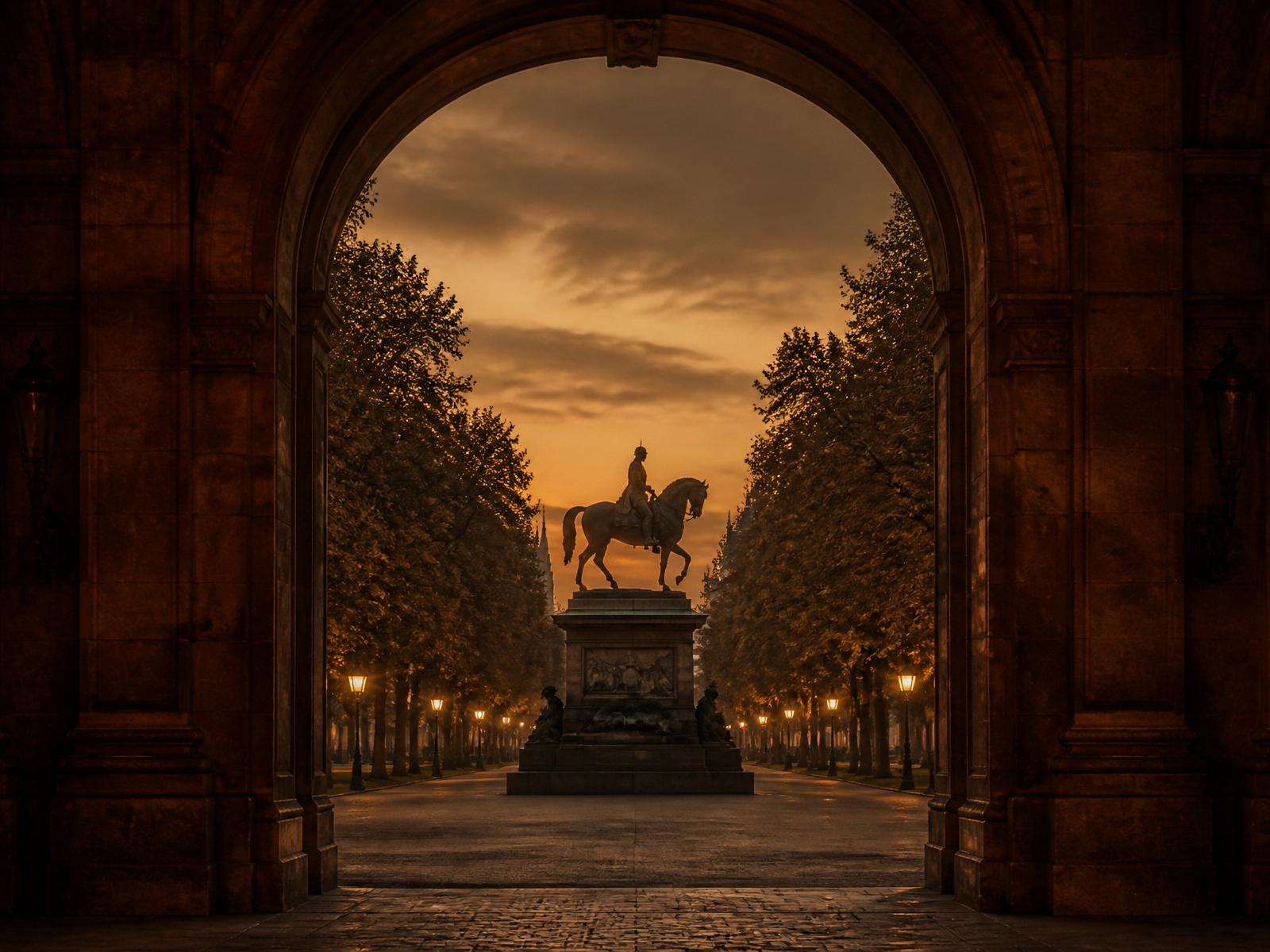
Then she found herself beneath an old arch at the beginning of a broad avenue.
She stopped.
Beyond it, the avenue stretched towards the horizon.
Trees lined either side.
A rider on horseback stood in the distance.
The last sunlight rested across the stone while the first lamps began to glow.
Her instinct was immediate.
She reached for the camera.
Studied the composition.
Moved left.
Then right.
Adjusted the lens.
Waited.
She knew the image was there.
She had spent a lifetime knowing when a photograph was about to happen.
Then she remembered a painter she had photographed years earlier.
He had worked intensely at a canvas, then stepped away.
A few paces.
Looked.
Returned.
Then stepped away again.
She had once asked why.
He had shrugged.
“You stop seeing things when you stand too close for too long.”
At the time, she had written it down and moved on.
Now she understood.
She lowered the camera.
One step back.
Another.
Then a third.
The city hadn’t changed.
She had.
She could see the avenue, the buildings, the statue, the lamps beginning to glow.
And then, almost without warning, she could see the places she had been.
Australia. Japan. India. Africa. New Zealand.
The years in Europe.
The long journeys.
The short ones.
The hotel rooms.
The trains.
The tables where strangers had made room for her.
The people who had challenged her.
The people who had welcomed her.
The people whose names she remembered.
The people whose names she had forgotten but whose stories had stayed.
She thought about the craftsman.
He had taught her patience without pretending he had mastered it.
The restaurateur had reminded her that a life could be rich without constantly moving.
The young artist had reminded her that leaving takes courage, but so does staying.
The bookseller had made her question what it really meant to preserve a story.
And the young woman at the gallery had made her realise that she could spend a lifetime looking at the world and still forget to look at herself.
None of them had given her an answer.
They had given her something better.
Perspective.
She had once thought she was collecting stories.
Now she wondered whether the stories had been collecting her.
Every journey had changed something.
Every person had left something behind.
A question.
A memory.
A different way of seeing.
A small change in the direction she was travelling.
Her photographs were not simply a record of where she had been.
They were a record of who she had become while she was there.
And perhaps that was why she had never felt finished.
There would always be another person.
Another place.
Another conversation.
Another photograph waiting somewhere beyond the frame.
She didn’t want the world to become smaller.
She wanted to remain curious enough for it to keep becoming larger.
The light was almost gone.
She raised the camera again.
This time, she didn’t try to perfect the scene.
She simply let it be what it was.
The stone. The avenue. The rider. The fading sky. The lamps. The people.
She pressed the shutter.
Then lowered the camera without checking the image.
She didn’t need to know whether she had captured it perfectly.
She had been there.
That was enough.
She stood beneath the arch for another moment.
She thought about how rarely people gave themselves permission to do this.
To step outside the constant movement of their own lives.
To stop asking what comes next.
To look back without trying to rewrite what happened.
To look around without immediately reaching for the next thing.
To see the shape of the life they had made.
She had spent decades learning how to move closer.
Closer to people.
Closer to places.
Closer to stories.
Closer to the perfect image.
But sometimes the most important movement was backwards.
Three steps.
Just enough distance to see what all the individual pieces had become together.
She hadn’t stopped travelling.
She hadn’t finished photographing.
She hadn’t run out of stories.
Quite the opposite.
There was still so much of the world she had yet to see.
So many people whose stories she had yet to hear.
So many places that might change her in ways she could not yet imagine.
She would keep going.
Keep asking questions.
Keep crossing paths.
Keep listening.
Keep looking.
But perhaps now she would sometimes put the camera down.
Stay a little longer.
Listen a little more.
Look twice.
And when a moment asked nothing of her except to be present, she would allow it to be enough.
She looked down the avenue.
The last light disappeared.
Then she looked at the photograph.
Something caught her attention.
At the far edge of the frame, almost hidden between two buildings, was a narrow street she hadn’t noticed when she first composed the image.
It caught a final trace of light.
She couldn’t see where it led.
For years, that would have been enough to make her reach for the camera.
This time, she simply stood there.
She wondered.
Then smiled.
Tomorrow she was due to leave San Aurelio.
There was another assignment waiting.
Another city.
Another set of names she didn’t know yet.
Another story somewhere beyond the frame.
She slipped the camera into its case.
Then began walking.
After a few steps, she stopped and looked back once.
The street was still there.
So was the question.
She smiled again.
She had spent much of her life searching for the next story.
Perhaps the best ones were the ones you couldn’t see coming.
And somewhere beyond the edge of the photograph, something was waiting.
She just didn’t know what it was yet.
For the first time in a long time, she was glad.
Continue the thread
The story
What We Leave Standing
An architect who had spent thirty years imagining what comes next finds, beneath an old steel crossing on the edge of London, a question she had never thought to ask.
Open